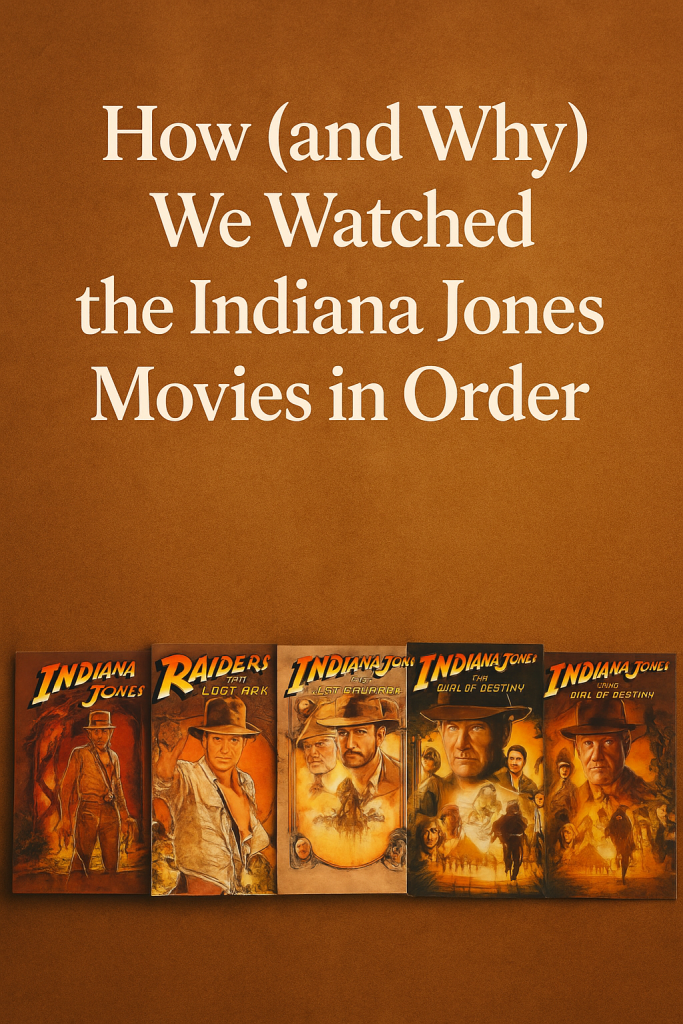
We decided to go on an adventure—one that involved fedoras, whips, ancient relics, and a whole lot of Harrison Ford. But instead of jumping around or following release dates, we chose to watch the Indiana Jones movies in chronological order. Here’s the path we took:
- Indiana Jones and the Temple of Doom (1984)
- Raiders of the Lost Ark (1981)
- Indiana Jones and the Last Crusade (1989)
- Indiana Jones and the Kingdom of the Crystal Skull (2008)
- Indiana Jones and the Dial of Destiny (2023)
- Skipped: The Young Indiana Jones Chronicles (2000) — don’t own it.
Why This Order?
There’s something satisfying about seeing a character evolve over time, especially one as iconic as Indy. Watching the movies in the order of his life—not the order the world saw them—let us trace his growth from rough-edged adventurer to the reflective, weary, still-badass professor in Dial of Destiny.
The Descent Into the Adventure (Temple → Raiders)
Starting with Temple of Doom was… intense. It’s easily the darkest and wildest of the bunch, and it throws you headfirst into Indy’s world with zero hand-holding. But once the dust and lava settle, Raiders of the Lost Ark feels like a breath of fresh air—more balanced, still action-packed, but with that perfect blend of adventure and wit that made Indy a legend.
By beginning with Temple, we saw him at his most raw and impulsive. Then Raiders reminded us of why he became a hero in the first place.
Peak Indy (Last Crusade)
The Last Crusade was Indy in his prime. We got the smarts, the action, the heart, and—bonus points—the brilliant dynamic with Sean Connery. Watching this after Raiders felt like watching a sequel that actually respected the character’s development. Indy wasn’t just chasing artifacts anymore; he was confronting his past, his family, and the legacy he was building.
The Older Years (Crystal Skull → Dial of Destiny)
Kingdom of the Crystal Skull doesn’t get enough love, in my opinion. Sure, it’s got its over-the-top moments (fridge, anyone?), but watching it in sequence gave it more emotional weight. We’d seen Indy grow up—now we got to see him age. He’s slower, but still sharp. Wiser, but still full of grit. And that made it feel earned.
Then came Dial of Destiny, the final chapter (for now). It hit different after watching everything else first. It’s not a perfect movie, but it felt right. There’s something powerful about seeing a man who’s spent his life running, chasing, escaping—finally slowing down and asking himself what it was all for.
What About Young Indy?
We skipped The Young Indiana Jones Chronicles—partly because we don’t have access to them, and partly because we felt like we got what we needed. The movies gave us a complete arc, from bold and brash to thoughtful and legacy-minded. Maybe one day I’ll circle back and fill in the true origin story.
Final Thoughts
Watching the Indiana Jones saga in order wasn’t just fun—it was surprisingly emotional. You see not just the adventures, but the toll, the change, the growth. Indy isn’t just a character who fights Nazis and uncovers artifacts—he’s a man who questions the world, loses people he loves, and keeps going anyway.
And that’s the real treasure in these movies—not the relics, but the journey.